HEFA
Hydroprocessed Esters and Fatty Acids converts qualifying lipid feedstocks, such as certain waste oils and fats, into aviation-fuel components.
Sustainable Aviation Fuel
Sustainable Aviation Fuel is designed to reduce aviation's lifecycle emissions while maintaining the safety and performance requirements expected of aviation turbine fuel when produced, qualified and blended under applicable standards.

What is SAF?
Sustainable Aviation Fuel, commonly called SAF, is aviation turbine fuel produced from eligible renewable or non-fossil inputs through approved industry pathways.
Before reaching an aircraft, SAF must be produced and qualified to applicable requirements, blended where required, and managed through aviation-fuel quality and handling systems.
Depending on the approved pathway and blend, SAF can work with existing aircraft and fuel infrastructure. Its lifecycle-emissions performance is assessed across feedstock, production, transport and use, and varies by pathway and supply chain.
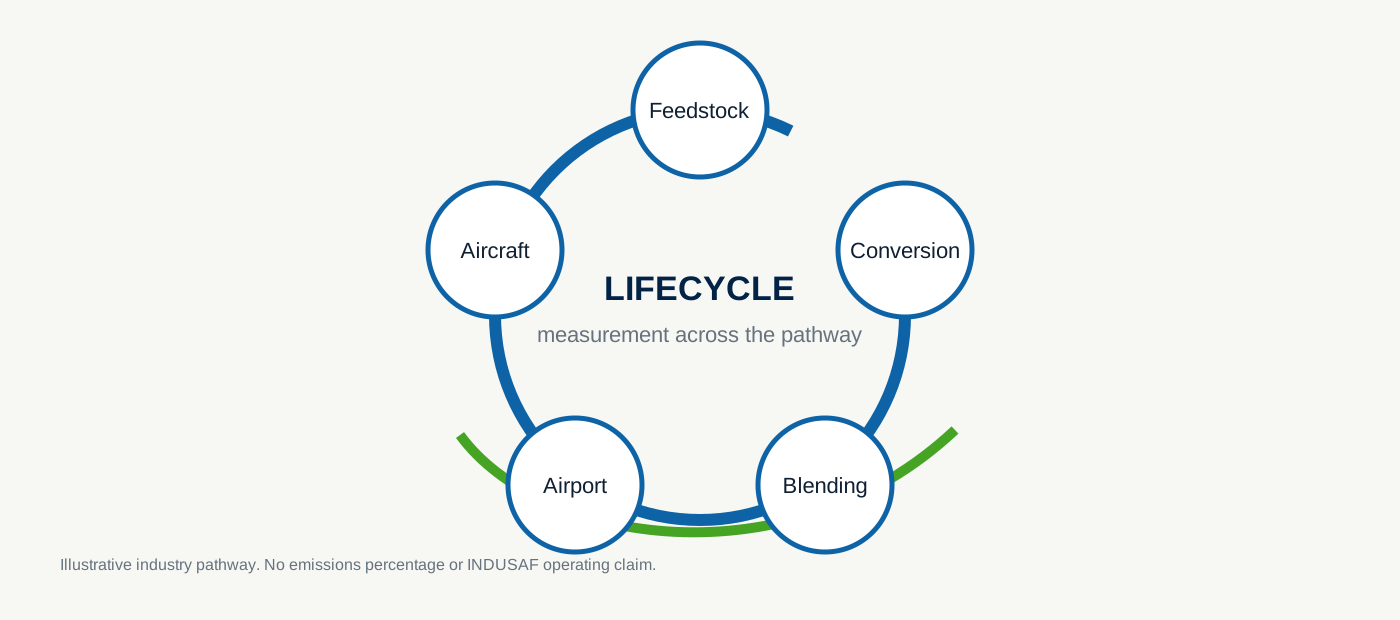
How SAF reaches an aircraft
An industry SAF pathway may include the following stages. The precise route depends on the feedstock, production pathway, applicable standards and supply arrangement.
Educational industry pathway. This does not state that every stage is operated directly by INDUSAF.
Potential SAF pathways
The aviation-fuel industry is developing and using multiple pathways. INDUSAF does not claim current production across all pathways listed below.
Hydroprocessed Esters and Fatty Acids converts qualifying lipid feedstocks, such as certain waste oils and fats, into aviation-fuel components.
Alcohol-to-Jet converts eligible alcohol intermediates, including ethanol from qualifying sources, into aviation-fuel components.
Co-processing introduces qualifying renewable feedstocks alongside conventional refinery streams under applicable pathway and blending limits.
Synthetic or Power-to-Liquid routes can combine low-emissions hydrogen with a suitable carbon source to produce aviation-fuel components.
Feedstocks
Feedstock eligibility, provenance, availability and lifecycle performance must be evaluated within the requirements of the selected pathway.
Feedstock categories are educational. No sourcing contracts are claimed.

Applications
Quality & certification
Aviation fuel requires disciplined testing, documentation, traceability, handling and conformity with applicable standards.
Sustainability attributes also require appropriate chain-of-custody records and recognised verification where relevant. INDUSAF does not claim certification status on this approval-stage page.
Compliance & Quality